> How to Avoid Fake Discounts: 10 Smart Ways to Tell If a Deal Is Actually Worth It You find a coffee maker you've been watching for weeks. Yesterday it cost $99. Today, a bright red banner announces "50% OFF – Today Only!" and the new price is $79.
It feels like the perfect time to buy.
But after spending two minutes comparing prices on a few other websites, you discover something surprising: the same coffee maker has been selling for around $80 at several retailers for nearly a month.
The discount wasn't fake in the legal sense—but it certainly wasn't the incredible bargain the advertisement made it seem to be.
Situations like this happen every day.
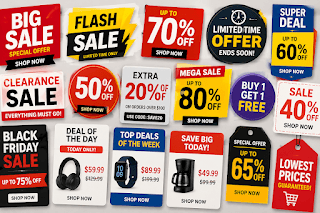
Retailers know that shoppers respond emotionally to words like sale, limited time, exclusive offer, and clearance. When combined with countdown timers, bright colors, and large percentage discounts, these marketing techniques can convince people to make purchases they hadn't planned.
That doesn't mean every sale is misleading. Many stores offer genuine discounts during seasonal events, holiday promotions, or when clearing inventory.
The challenge is knowing the difference.
In this guide, we'll explain the most common pricing tricks retailers use, how to verify whether a discount is genuine, and the simple habits smart shoppers use to avoid paying more than they should.
________________________________________
1. Don't Judge a Deal by the Percentage
One of the biggest mistakes shoppers make is focusing on the discount percentage instead of the final price.
A 70% discount sounds far more exciting than a 20% discount, but percentages can be surprisingly misleading.
Imagine these two offers:
• Product A: Was $300, now $150 (50% off)
• Product B: Was $190, now $140 (26% off)
Most people instinctively choose Product A because the discount looks larger.
However, if Product A has been selling for around $160 at multiple retailers for months, while Product B genuinely dropped from $190 to $140 for a limited promotion, Product B may actually represent the better value.
The lesson is simple:
Ignore the percentage for a moment and ask one question: "Is today's price actually lower than what people normally pay?"
That question will save you far more money than chasing the biggest percentage displayed on a website.
________________________________________
2. The "Original Price" Isn't Always the Real Price
Many online stores display two prices:
$199.99
The crossed-out number naturally becomes the reference point in your mind. Psychologists call this price anchoring.
Once you see $199, paying $99 suddenly feels like a bargain—even if the product has rarely, if ever, sold for $199.
This doesn't necessarily mean the retailer is being dishonest. Sometimes the higher number is the manufacturer's suggested retail price (MSRP), not the store's actual selling price.
That's why experienced shoppers rarely trust the crossed-out price alone.
Instead, they compare the current price across several reputable retailers. If everyone else is selling the same product for roughly the same amount, the advertised "discount" may simply be clever presentation rather than exceptional savings.